


Why do white striped fitted sheets made of polyester-cotton blends maintain clear stripes and prevent distortion even after frequent machine washing?
Release Time : 2026-01-08
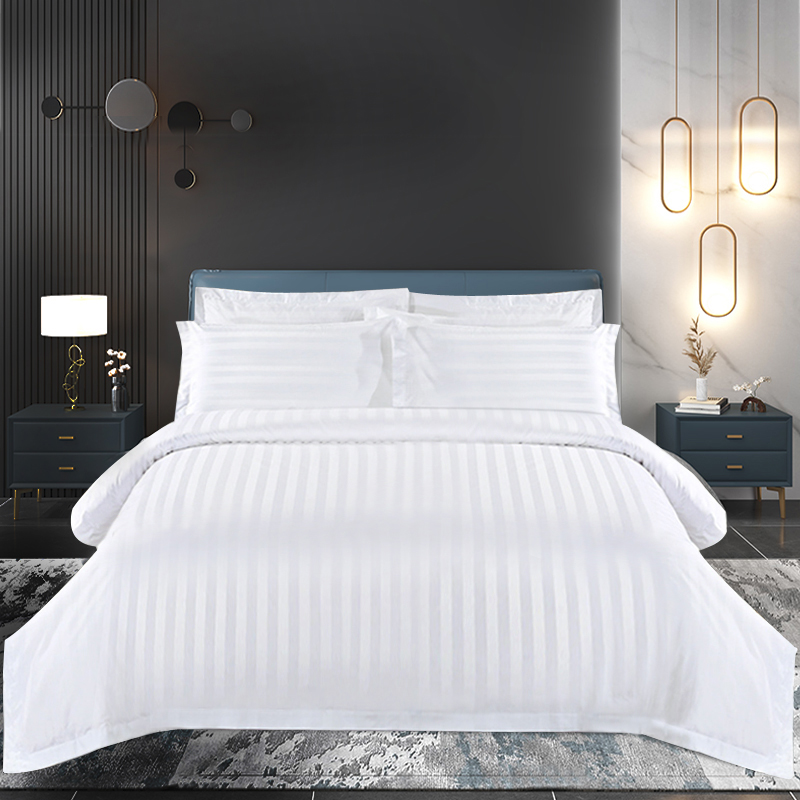
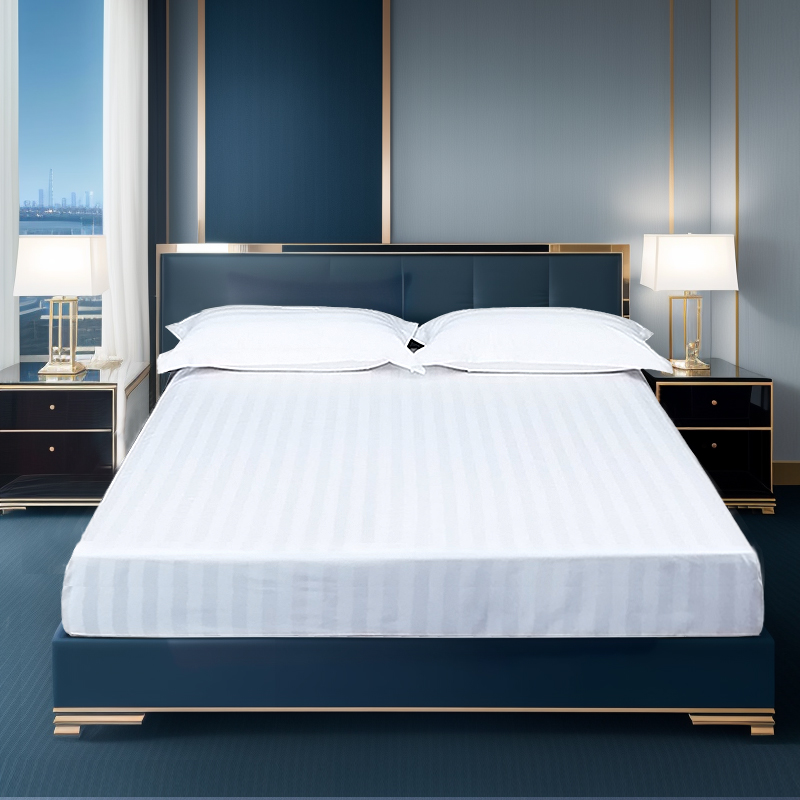
In daily home life, fitted sheets, as bedding that comes into direct contact with the skin and is used frequently, not only need to be comfortable against the skin but also need to withstand repeated washing and stretching. White striped fitted sheets, with their simple and elegant visual effect, have become the first choice for many families. However, what is commendable is that even after dozens or even hundreds of machine washes, their striped patterns remain clear and straight, without obvious distortion or fading. This "lasting goodness" performance is inseparable from the scientific ratio of polyester-cotton blend fabric, advanced weaving technology, and multiple guarantees of structural stability design.
1. Polyester-Cotton Blend: Balancing Dimensional Stability and Deformation Resistance
Polyester-cotton blends typically use a classic ratio of 65% polyester and 35% cotton, cleverly combining the advantages of both fibers. Polyester has extremely low moisture absorption and swelling rate and excellent elastic recovery, almost no shrinkage when wet, and high tensile strength; while cotton fibers, although soft and absorbent, are prone to shrinkage and deformation. By blending the two, the polyester skeleton effectively "locks in" the deformation tendency of the cotton fibers, allowing the overall fabric to maintain a stable warp and weft structure even when wet. This dimensional stability is the foundation for the stripe pattern to remain unchanged—if the fabric undergoes anisotropic shrinkage during washing, the stripes will inevitably become skewed or wavy. Polyester-cotton blends significantly suppress such problems.
2. Precision Weaving and Yarn Pretreatment: Controlling Stripe Precision from the Source
The stripes on the white striped fitted sheet are not printed later, but achieved through a yarn-dyed process—that is, before weaving, the warp or weft yarns are dyed white and another color according to the design pattern before being woven. This process requires extremely high yarn tension and loom precision. High-quality products undergo high-temperature setting or anti-shrinkage pretreatment of the polyester-cotton blend yarn before weaving to eliminate internal stress; during weaving, high-density, high-tension controlled rapier looms or air-jet looms are used to ensure that each stripe yarn is precisely positioned and consistently spaced. Stripes woven in this way inherently possess "anti-twist genes," and even after subsequent washing, their strong structure makes them difficult to shift.
3. Finishing and Setting: Giving the Fabric "Memory" Smoothness
The finished fabric undergoes a crucial finishing process—heat setting. Under high temperature and tension control, the fabric is quickly dried and "remembers" its smooth state. This process rearranges and solidifies the polyester molecular chains, further improving dimensional stability and wrinkle resistance. For striped fitted sheets, setting also ensures that the stripe direction is strictly parallel to the selvage, preventing visual distortion caused by fabric looseness. Furthermore, some high-end products apply environmentally friendly resin finishing agents, forming a micro-crosslinked network on the fiber surface, enhancing wrinkle resistance and shape retention, allowing the stripes to quickly return to their original shape after multiple rubbing and washing.
Fitting sheets have elastic bands at the four corners, which are frequently stretched during use. If the fabric's extensibility is uneven, the stripes are prone to stretching and deformation at the corners. High-quality polyester-cotton blend fitted sheets avoid this problem through the following design features: First, they use two-way elastic binding or high-elasticity elastic bands to distribute stress; second, they ensure that the warp and weft elastic moduli of the fabric are similar to avoid unidirectional stretching; third, the stripe direction is usually set along the length of the fitted sheet, consistent with the main stress direction, reducing lateral shear deformation. These details together ensure the geometric integrity of the stripes during actual use and washing cycles.
5. Colorfastness and Anti-Yellowing Treatment: Protecting the Purity of "White + Stripes"
White bases are prone to yellowing, and colored stripes are prone to fading, both of which damage the clarity of the pattern. Modern polyester-cotton blend fitted sheets generally use high-fastness reactive dyes or vat dyes, and add anti-yellowing agents to the white parts. The polyester component itself has excellent light and wash resistance. Therefore, even with long-term sun exposure or frequent washing, the stripe boundaries remain sharp and distinct, and the white areas remain clean as ever.
The white striped fitted sheet is a culmination of materials science, textile engineering, and home aesthetics. Not only does its crisp, clean appearance enhance the quality of the bedroom, but its durable quality—"won't be damaged by washing, won't deform, and won't lose its shape"—also embodies the modern home textile industry's dual pursuit of practicality and aesthetics. In a fast-paced life, such bedding that requires no ironing and remains as good as new over time is a gentle testament to an ideal life.
1. Polyester-Cotton Blend: Balancing Dimensional Stability and Deformation Resistance
Polyester-cotton blends typically use a classic ratio of 65% polyester and 35% cotton, cleverly combining the advantages of both fibers. Polyester has extremely low moisture absorption and swelling rate and excellent elastic recovery, almost no shrinkage when wet, and high tensile strength; while cotton fibers, although soft and absorbent, are prone to shrinkage and deformation. By blending the two, the polyester skeleton effectively "locks in" the deformation tendency of the cotton fibers, allowing the overall fabric to maintain a stable warp and weft structure even when wet. This dimensional stability is the foundation for the stripe pattern to remain unchanged—if the fabric undergoes anisotropic shrinkage during washing, the stripes will inevitably become skewed or wavy. Polyester-cotton blends significantly suppress such problems.
2. Precision Weaving and Yarn Pretreatment: Controlling Stripe Precision from the Source
The stripes on the white striped fitted sheet are not printed later, but achieved through a yarn-dyed process—that is, before weaving, the warp or weft yarns are dyed white and another color according to the design pattern before being woven. This process requires extremely high yarn tension and loom precision. High-quality products undergo high-temperature setting or anti-shrinkage pretreatment of the polyester-cotton blend yarn before weaving to eliminate internal stress; during weaving, high-density, high-tension controlled rapier looms or air-jet looms are used to ensure that each stripe yarn is precisely positioned and consistently spaced. Stripes woven in this way inherently possess "anti-twist genes," and even after subsequent washing, their strong structure makes them difficult to shift.
3. Finishing and Setting: Giving the Fabric "Memory" Smoothness
The finished fabric undergoes a crucial finishing process—heat setting. Under high temperature and tension control, the fabric is quickly dried and "remembers" its smooth state. This process rearranges and solidifies the polyester molecular chains, further improving dimensional stability and wrinkle resistance. For striped fitted sheets, setting also ensures that the stripe direction is strictly parallel to the selvage, preventing visual distortion caused by fabric looseness. Furthermore, some high-end products apply environmentally friendly resin finishing agents, forming a micro-crosslinked network on the fiber surface, enhancing wrinkle resistance and shape retention, allowing the stripes to quickly return to their original shape after multiple rubbing and washing.
4. Optimized Structural Design: Reducing Mechanical Stress Concentration During Use
Fitting sheets have elastic bands at the four corners, which are frequently stretched during use. If the fabric's extensibility is uneven, the stripes are prone to stretching and deformation at the corners. High-quality polyester-cotton blend fitted sheets avoid this problem through the following design features: First, they use two-way elastic binding or high-elasticity elastic bands to distribute stress; second, they ensure that the warp and weft elastic moduli of the fabric are similar to avoid unidirectional stretching; third, the stripe direction is usually set along the length of the fitted sheet, consistent with the main stress direction, reducing lateral shear deformation. These details together ensure the geometric integrity of the stripes during actual use and washing cycles.
5. Colorfastness and Anti-Yellowing Treatment: Protecting the Purity of "White + Stripes"
White bases are prone to yellowing, and colored stripes are prone to fading, both of which damage the clarity of the pattern. Modern polyester-cotton blend fitted sheets generally use high-fastness reactive dyes or vat dyes, and add anti-yellowing agents to the white parts. The polyester component itself has excellent light and wash resistance. Therefore, even with long-term sun exposure or frequent washing, the stripe boundaries remain sharp and distinct, and the white areas remain clean as ever.
The white striped fitted sheet is a culmination of materials science, textile engineering, and home aesthetics. Not only does its crisp, clean appearance enhance the quality of the bedroom, but its durable quality—"won't be damaged by washing, won't deform, and won't lose its shape"—also embodies the modern home textile industry's dual pursuit of practicality and aesthetics. In a fast-paced life, such bedding that requires no ironing and remains as good as new over time is a gentle testament to an ideal life.